Mos Burger Dinner

Dinner at MOS Burger has a quiet, almost ordinary kind of comfort—the kind you notice more when you pause long enough to really look.

On the table: two burgers in glossy buns, fries tucked into paper sleeves, and iced drinks sweating in clear plastic cups. It’s fast food, sure, but it feels carefully arranged, like a small still life in the middle of a busy day. The light is soft, the wood grain is warm, and everything seems to wait for the first bite.

There’s something reassuring about meals like this in Japan. Not because they’re extravagant, but because they’re steady. Familiar shapes, small unfamiliar details. The wrappers are printed with tidy little icons. The fries are crisp and simple. The burgers are pleasantly messy—lettuce slipping, sauce pressed into the paper.

I like how moments like this don’t demand much. You sit, you unwrap, you drink something cold, and for a few minutes the day narrows down to the sound of ice and the easy rhythm of eating. Outside, the city keeps moving. Inside, dinner is just a round table, a couple of burgers, and the small satisfaction of being exactly where you are.

Snacks in Maid Cafe

There’s something quietly comforting about a table that doesn’t ask for much: a warm pot of tea, a few small plates, the soft clink of porcelain against dark wood.

At Cure Maid Cafe in Japan, the snacks arrive like a little still life. White teapots with a delicate logo sit near cups of amber tea, and slices of cake rest on plain plates as if they’ve been set down to cool in a calm room. In the center, a glass dessert glows in layers—blue at the bottom, pale cream above—topped with fruit that feels bright against the muted tones of the table.

It isn’t a grand meal, and that’s part of what makes it linger in your mind. The portions are small enough to let you keep talking, to keep watching the room, to let the moment stretch without hurrying you toward the end.

I like places like this for their gentle attention to detail—the kind that doesn’t show off, just quietly holds everything together. A pot of tea can be ordinary anywhere, but here it feels like a small ritual: something warm to wrap your hands around while the outside world keeps moving.

If you’re planning a visit, go with time to spare. The best part isn’t only the sweets—it’s the pause they create.

Neon City Lights at Night

Tokyo at night feels like a second weather system—light instead of snow, heat instead of cold. In Shinjuku, the glow stacks up in layers: signs, windows, screens, and reflections that turn the street into something almost physical.

This is the kind of brightness that doesn’t erase shadows; it makes them sharper. A tall tower of blue lines holds steady in the distance while the street level churns with smaller lights and moving silhouettes. You can stand still and watch the city live alongside you, as if it’s breathing through cables and concrete.

Neon City Lights at Night is a simple title, but the scene is anything but simple. It’s crowded without feeling claustrophobic, loud without needing sound. There’s a particular calm hidden inside the spectacle—a reminder that even the most electric places become familiar once you let them.

I keep thinking about how cities store memories the way old houses do. Not in quiet creaks and settling boards, but in repeated routes, in signs you recognize before you can read them, in the soft hum of movement that never fully stops. Under all that color, the street is still just a street—waiting for you to walk through it and leave with something you didn’t plan to carry.

Ready to Soak

There’s something quietly reassuring about a small, bright room designed for one purpose: to let the day loosen its grip.

In Tokyo, the bath isn’t an afterthought. It’s a ritual tucked into clean lines and warm wood tones, a deep tub filling steadily while the sink runs beside it, as if the whole space is breathing in and out. Bottles sit in a neat row, waiting their turn. The mirror holds the scene like a window—water turning pale and cloudy, the surface trembling, then settling.

Ready to Soak feels less like an announcement and more like permission. Permission to be still for a moment. Permission to let travel be ordinary and human: tired legs, a long walk back, the soft click of a bathroom door, steam rising into a quiet ceiling.

I like how places can carry their own kind of care. Not loud, not luxurious in the flashy way—just thoughtful. A room that doesn’t ask you to perform, only to show up.

Tonight the city can keep humming outside. Inside, the bath fills, the air warms, and time slows to the pace of water.

Beautiful Temple Day

There are days when a place feels like it has been waiting for you—quietly, without urgency—until you finally arrive.

Beautiful Temple Day didn’t start as anything grand. Just a bright sky, a little heat on the shoulders, and that slow pull of trees gathering around a path. Then the torii gate rose up in front of me, all weathered wood and clean lines, framed by leaves and a wide, open blue. Standing beneath it, I felt that familiar shift: one world pressing up against another, the ordinary thinning at the edges.

The gate wasn’t shouting for attention. It didn’t need to. The grain of the wood held its own history, darkened by time, sun, and rain. And above, the light made everything feel briefly simpler—like you could hear your own thoughts without them echoing back as noise.

I lingered longer than I meant to. Not out of ceremony, exactly, but out of a kind of respect for the stillness. Places like this don’t demand belief. They invite pause. They remind you that you can step out of your day for a moment and come back a little lighter.

Maybe that’s all a beautiful temple day really is: a small crossing, a breath, and a quiet return.

Dance Robots Dance

The night in Shinjuku feels like it runs on electricity. Light doesn’t just hang in the air—it moves, it pulses, it leans into the crowd and asks you to lean back.

Dance Robots Dance is the simplest way to name what happens in that room, but the scene is bigger than the words. A metallic figure catches every laser line and throws it back in sharp color. Across the floor, other glowing shapes flicker and spin, like a future made from reflections and noise. The audience gathers shoulder to shoulder, faces turned toward the stage, watching the spectacle the way you watch a storm—half delighted, half braced for the next flash.

There’s something oddly human in it: the choreography, the timing, the small pauses that let the room breathe before the lights slice through again. Among all the neon and chrome, you still feel that familiar push and pull—wonder, curiosity, the sense that one world is pressing right up against another.

Later, when the music fades, what stays is the color. The memory of pink and green beams crossing above a crowd. The idea that Tokyo can make even a noisy night feel secret, like you stumbled into it by accident and got to keep it for a moment.

Tsukiji Sushi Lunch

Tsukiji has a way of making lunch feel like a small pilgrimage. You drift down a narrow street stitched with power lines and shop signs, past counters and awnings, past people moving with that steady, practiced pace of a place that’s been doing the same work for a long time.

A banner for grilled tuna flaps above the crowd like a bright, simple promise. The air feels busy even when you stand still—salt, smoke, and something sweet you can’t quite name. It’s ordinary in the way that good places are ordinary: built from routine, repetition, and hands that know what they’re doing.

I came for sushi, but the walk there mattered as much as the first bite. Tsukiji isn’t quiet, yet it carries a kind of calm under the noise. You watch one world push up against another—tourists pausing to point, locals slipping through, vendors calling out, knives flashing briefly and disappearing back into work.

Then lunch arrives: clean cuts of fish, rice pressed just right, a bite that tastes like the sea without trying to explain itself. You don’t need much more than that. You finish, step back into the street, and the market keeps flowing as if nothing happened—except you’re a little more awake than you were before.

Exploring Tokyo day 2

Tokyo, day two, and I find myself looking down more than up.

In Asakusa, the street has its own quiet language: textured pavement, a yellow tactile strip running along the edge, and a manhole cover set like an emblem in the ground. The cover is patterned like a flower—metal petals, small dots, a careful symmetry—proof that even the parts of a city built to be stepped over can still be made with attention.

My shoes hover at the bottom of the frame, toes angled toward it, like I’ve walked into a small, accidental still life. It’s an unremarkable corner of sidewalk, yet it feels like a postcard of how Tokyo works: practical first, then quietly beautiful.

Walking through Asakusa today, I kept noticing how the city repeats itself in tiny ways. Grooves in the curb. The grit of concrete. The steady promise of that yellow line, guiding people who need it and reminding everyone else to make room. The streets don’t demand that you understand them all at once. They teach you by repetition.

By late afternoon, I realized day two wasn’t about collecting sights. It was about learning Tokyo from the ground up—one pattern, one step, one small pause at a time.

Breakfast Temple Visit

Tokyo in the morning has a different temperature to it—less hurry, more hush. I arrived at Senso-ji with breakfast still warm in my stomach and the feeling that the day hadn’t decided what it would become yet.

At the gate, the giant lantern hangs like a steady heartbeat. Red beams frame it overhead, and the paint and paper look both weathered and cared for, the way old places do when they’re allowed to keep their age. There’s something grounding about standing beneath something so familiar in photos and finally noticing the details: the creases, the rope, the quiet weight of it all.

I’ve learned that travel isn’t always the big sights—it’s the small moments where one world brushes up against another. A temple visit after breakfast feels simple, almost ordinary, and maybe that’s the point. You walk in, you look up, you slow down. For a few minutes, the city doesn’t ask anything from you.

Senso-ji holds that kind of space. Not empty, not silent—just settled. Like it’s been listening for a long time, and it’s in no rush to answer.

If you ever find yourself in Tokyo early, go before the day gets loud. Let the lantern be the first thing you really look at.

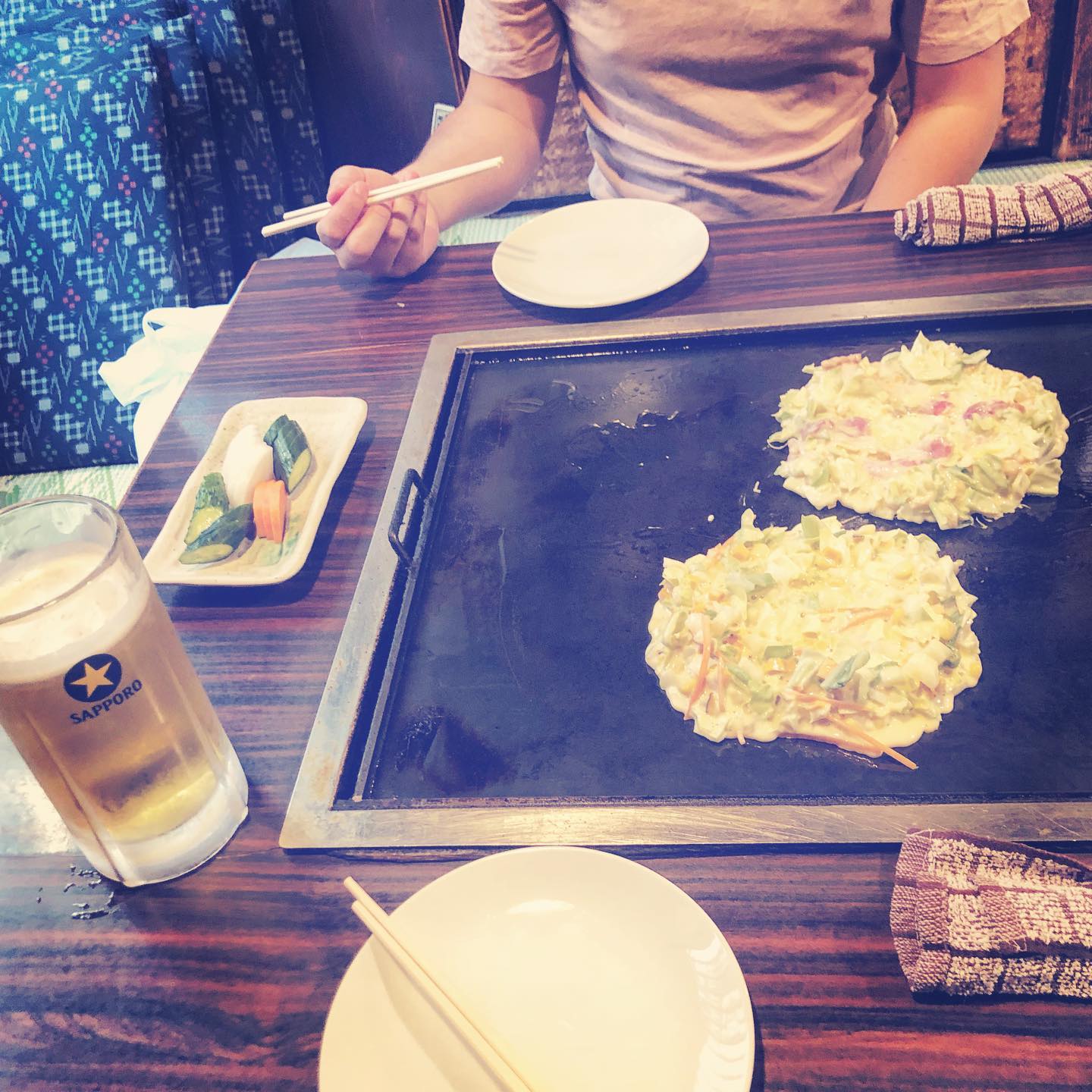
Okonomiyaki first meal – Sometaro

Our first meal in Japan was okonomiyaki at Sometaro—simple, warm, and a little mesmerizing.

The griddle sat in the middle of the table like a small, black stage. Two pale rounds of cabbage and batter sizzled quietly, edges loosening as if they were waking up. Steam rose and disappeared. Chopsticks hovered. A cold beer sweated beside a small plate of pickles, the kind of everyday details that make travel feel less like a highlight reel and more like a real afternoon you get to keep.

There’s something grounding about cooking at the table. You’re forced to slow down and watch. The food doesn’t arrive finished; it becomes dinner in front of you. The room around us faded into small sounds—the scrape of metal, the soft chatter, the steady hiss—until it felt like the whole city had narrowed to that warm rectangle.

Okonomiyaki is comfort food with a little ceremony: turn, wait, share, eat while it’s hot. It was the kind of first meal that doesn’t try to impress, and somehow that makes it unforgettable. After the flight and the rush of arrival, Sometaro felt like a quiet welcome.

We are Officially Engaged

On a small table, two bottles of sake catch the light, and a handwritten note rests beside them like a keepsake you’ll want to fold carefully and save.

We are Officially Engaged.

It’s strange how a moment can feel both loud and quiet at the same time. Loud in the way it changes the shape of the future, quiet in the way the present keeps sitting there, steady, asking you to notice it. A simple table. A drink poured slowly. Ink on paper. The kind of details that become anchors later.

Tokyo has a way of making ordinary scenes feel cinematic. The city hums just beyond the room, and inside there’s this pocket of stillness where gratitude can finally land. This is what I want to remember: not just the announcement, but the tenderness of being cared for, the warmth of a shared toast, the soft weight of a new beginning settling in.

To everyone who has been cheering us on from near and far, thank you. We’re holding this close, taking it in, and letting it unfold one day at a time—together.

JFK > SEA, first leg of the trip to Japan

The cabin light has that familiar, late-afternoon glow—the kind that makes everything feel a little softer than it really is. I’m stretched out in my seat, shoes tucked forward, the screen in front of me running an ad about comfort and legroom, as if it’s trying to narrate the moment while I’m living it.

JFK > SEA is only the first leg, but it already feels like the threshold. Airports have their own weather: recycled air, muted announcements, the low tide of people moving with purpose. On the plane, time becomes something you can fold up and put away for later. The tray table clicks. The seat settles. A small pocket of stillness appears.

There’s a strange comfort in these in-between hours—suspended over the country, watching the world reduce itself to patterns and light. It’s not Japan yet, not even close, but the trip has started in the only way trips really start: by leaving.

Seattle is a pause, a breath, a handoff. Soon there will be different signs, different streets, different morning sounds. For now, I’m content to let the hum of the plane and the quiet choreography of travel do their work—carrying me forward while I sit still, thinking about the distance ahead and the stories waiting on the other side of it.

Exit mobile version