
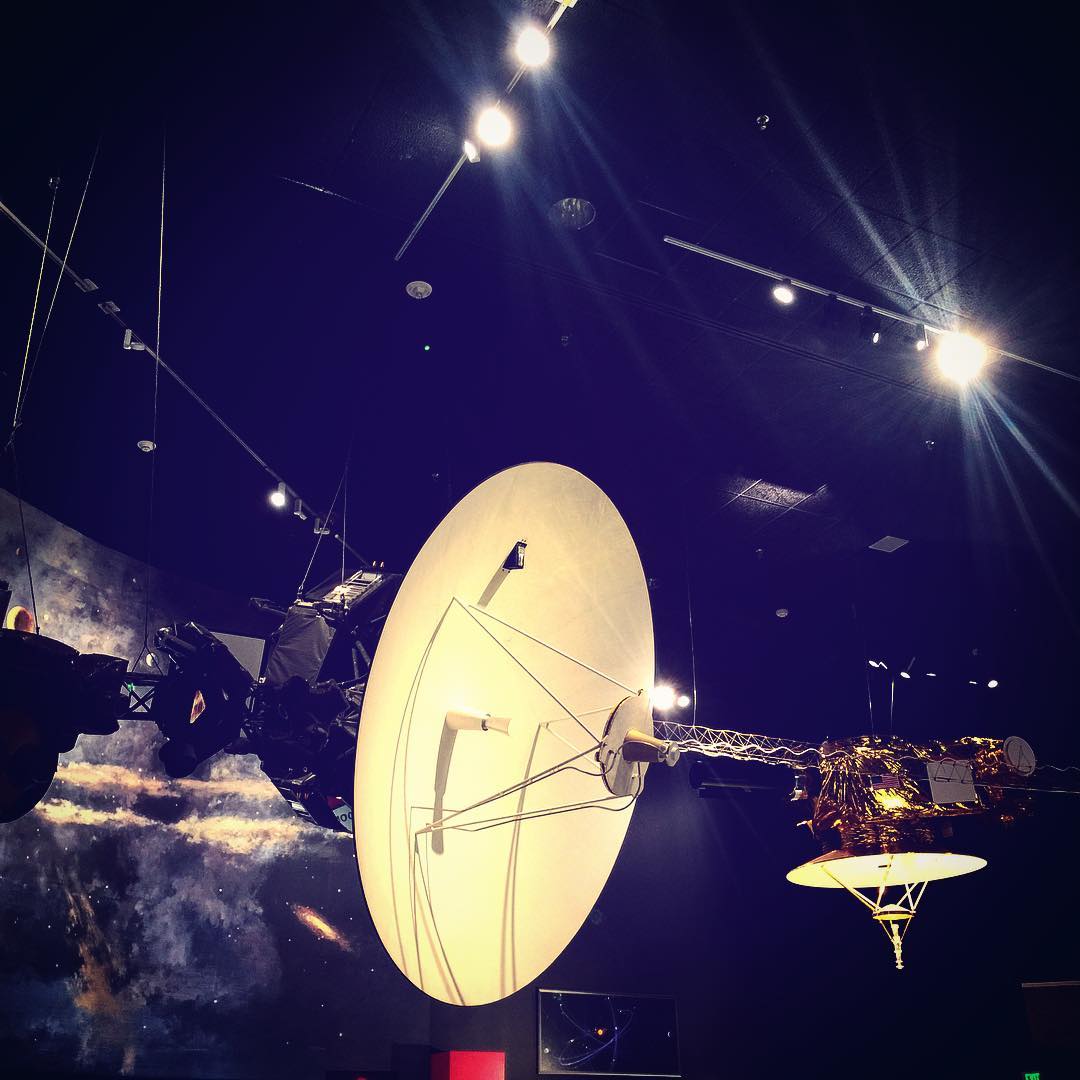
There’s something about standing beneath a satellite dish that makes the room feel bigger than it is. The ceiling disappears into black, punctured by bright museum lights, and the hardware hangs there like a paused sentence—part engineering, part daydream.
The dish’s clean curve points outward, as if it’s listening. Not just to space, but to the quiet between things: the static we usually ignore, the distance we can’t measure, the unknown we pretend is far away. Up close, it’s all struts and seams and careful angles—ordinary materials arranged into a kind of longing.
In Washington, DC, surrounded by exhibits and polished floors, I kept thinking about how the most enormous journeys begin in places like this: indoors, under lights, with a model you can walk around. We build these objects so we can imagine beyond ourselves. We send metal and gold foil into dark silence and call it exploration, but it’s also a way of admitting we’re curious—restless, even.
“Into the Unknown” sounds like a slogan until you’re standing under the dish and feel the scale of what it suggests. The unknown isn’t only out there. It’s in the way we look up, in the urge to travel without moving, in the small human hope that something is listening back.
And for a moment, the room hums with that possibility.
