Tokyo > NYC

Tokyo > NYC is the kind of comparison you can’t make with numbers. It’s something you feel in your pocket, in the quiet weight of a ticket stub, in the way a city follows you home.

I’m looking at a small skyline—an Empire State Building miniature—standing upright on a wooden table like it’s trying to prove something. Under it, a postcard flashes the familiar: lights, crowds, bright squares of color. There’s a paper marked “BROOKLYN,” and a small “I ♥ NY” tucked in close, like a charm meant to hold a moment in place.

Cities do that. They become objects, then memories, then a kind of weather you carry around. Tokyo feels like motion—clean lines, late trains, a sense of order that still leaves room for mystery. New York feels like friction—noise and energy and the strange comfort of being one face in a million.

Maybe “Tokyo > NYC” is just a mood, a snapshot taken mid-flight, when you can still hear one place while landing in another. But I like how the souvenirs argue quietly on the table. They don’t settle the question. They just remind me that travel isn’t about choosing a winner—it’s about noticing what each place wakes up inside you, and what follows you back through the door.

Morning Coffee

Morning Coffee

There’s a certain quiet ceremony to coffee in the morning—especially when the table is already set like a small still life. Porcelain cups, a dark pour that looks almost blue at the edges, a soft cappuccino foam dusted with something warm, and water glasses catching the light like little panes.

In Tokyo, even the simplest café table can feel carefully composed. Metal tray, tiny pitcher of milk, a polished sugar pot reflecting the room back at itself. A menu card resting in the middle like a note you haven’t opened yet. It’s all ordinary, and somehow it isn’t.

I like moments like this because they’re gentle proof that the day has started, but it hasn’t asked anything from you yet. You can sit with the small sounds—spoons against saucers, a chair shifting, ice settling in a glass—and let the city stay outside for a minute longer.

The first cup is about waking up. The second is about staying. And in between, there’s that brief, bright pause where everything feels simple enough to hold: warmth in your hands, cool water nearby, and the comfort of a table that doesn’t need you to rush.

If you ever need a reason to slow down, start here: one morning, one cup, one quiet corner of Tokyo.

Dyson is just as good as Hachiko

Dyson is just as good as Hachiko, or at least that’s what it felt like standing there in the bright Shibuya light—one world pressing up against another.

The Hachiko statue has a gravity to it. People orbit, pause, smile, move on. Bronze made warm by hands and time, set against the everyday rush of Tokyo. It’s easy to arrive expecting a simple photo spot and leave with something quieter: a reminder that loyalty can become a landmark, and that a city can hold tenderness in plain sight.

Dyson, meanwhile, is not cast in metal. He’s living and impatient and funny in the way a dog can be—present tense all the time. The comparison is unfair, and still it makes sense. Hachiko is the story we carry around; Dyson is the small, real version of it that waits at home (or in your mind) and makes the idea feel possible.

I like places that do this—where the mundane and the meaningful overlap without announcing themselves. A statue in a pocket of shade. A person posing beside it, trying to be lighthearted. A memory taking shape while traffic moves and the city keeps humming.

If you’re in Tokyo, go say hello to Hachiko. Stay a minute longer than you planned. Listen to the noise and see what it leaves behind.

Neon City Lights at Night

Tokyo at night feels like a second weather system—light instead of snow, heat instead of cold. In Shinjuku, the glow stacks up in layers: signs, windows, screens, and reflections that turn the street into something almost physical.

This is the kind of brightness that doesn’t erase shadows; it makes them sharper. A tall tower of blue lines holds steady in the distance while the street level churns with smaller lights and moving silhouettes. You can stand still and watch the city live alongside you, as if it’s breathing through cables and concrete.

Neon City Lights at Night is a simple title, but the scene is anything but simple. It’s crowded without feeling claustrophobic, loud without needing sound. There’s a particular calm hidden inside the spectacle—a reminder that even the most electric places become familiar once you let them.

I keep thinking about how cities store memories the way old houses do. Not in quiet creaks and settling boards, but in repeated routes, in signs you recognize before you can read them, in the soft hum of movement that never fully stops. Under all that color, the street is still just a street—waiting for you to walk through it and leave with something you didn’t plan to carry.

Ready to Soak

There’s something quietly reassuring about a small, bright room designed for one purpose: to let the day loosen its grip.

In Tokyo, the bath isn’t an afterthought. It’s a ritual tucked into clean lines and warm wood tones, a deep tub filling steadily while the sink runs beside it, as if the whole space is breathing in and out. Bottles sit in a neat row, waiting their turn. The mirror holds the scene like a window—water turning pale and cloudy, the surface trembling, then settling.

Ready to Soak feels less like an announcement and more like permission. Permission to be still for a moment. Permission to let travel be ordinary and human: tired legs, a long walk back, the soft click of a bathroom door, steam rising into a quiet ceiling.

I like how places can carry their own kind of care. Not loud, not luxurious in the flashy way—just thoughtful. A room that doesn’t ask you to perform, only to show up.

Tonight the city can keep humming outside. Inside, the bath fills, the air warms, and time slows to the pace of water.

Dance Robots Dance

The night in Shinjuku feels like it runs on electricity. Light doesn’t just hang in the air—it moves, it pulses, it leans into the crowd and asks you to lean back.

Dance Robots Dance is the simplest way to name what happens in that room, but the scene is bigger than the words. A metallic figure catches every laser line and throws it back in sharp color. Across the floor, other glowing shapes flicker and spin, like a future made from reflections and noise. The audience gathers shoulder to shoulder, faces turned toward the stage, watching the spectacle the way you watch a storm—half delighted, half braced for the next flash.

There’s something oddly human in it: the choreography, the timing, the small pauses that let the room breathe before the lights slice through again. Among all the neon and chrome, you still feel that familiar push and pull—wonder, curiosity, the sense that one world is pressing right up against another.

Later, when the music fades, what stays is the color. The memory of pink and green beams crossing above a crowd. The idea that Tokyo can make even a noisy night feel secret, like you stumbled into it by accident and got to keep it for a moment.

Tsukiji Sushi Lunch

Tsukiji has a way of making lunch feel like a small pilgrimage. You drift down a narrow street stitched with power lines and shop signs, past counters and awnings, past people moving with that steady, practiced pace of a place that’s been doing the same work for a long time.

A banner for grilled tuna flaps above the crowd like a bright, simple promise. The air feels busy even when you stand still—salt, smoke, and something sweet you can’t quite name. It’s ordinary in the way that good places are ordinary: built from routine, repetition, and hands that know what they’re doing.

I came for sushi, but the walk there mattered as much as the first bite. Tsukiji isn’t quiet, yet it carries a kind of calm under the noise. You watch one world push up against another—tourists pausing to point, locals slipping through, vendors calling out, knives flashing briefly and disappearing back into work.

Then lunch arrives: clean cuts of fish, rice pressed just right, a bite that tastes like the sea without trying to explain itself. You don’t need much more than that. You finish, step back into the street, and the market keeps flowing as if nothing happened—except you’re a little more awake than you were before.

Exploring Tokyo day 2

Tokyo, day two, and I find myself looking down more than up.

In Asakusa, the street has its own quiet language: textured pavement, a yellow tactile strip running along the edge, and a manhole cover set like an emblem in the ground. The cover is patterned like a flower—metal petals, small dots, a careful symmetry—proof that even the parts of a city built to be stepped over can still be made with attention.

My shoes hover at the bottom of the frame, toes angled toward it, like I’ve walked into a small, accidental still life. It’s an unremarkable corner of sidewalk, yet it feels like a postcard of how Tokyo works: practical first, then quietly beautiful.

Walking through Asakusa today, I kept noticing how the city repeats itself in tiny ways. Grooves in the curb. The grit of concrete. The steady promise of that yellow line, guiding people who need it and reminding everyone else to make room. The streets don’t demand that you understand them all at once. They teach you by repetition.

By late afternoon, I realized day two wasn’t about collecting sights. It was about learning Tokyo from the ground up—one pattern, one step, one small pause at a time.

Breakfast Temple Visit

Tokyo in the morning has a different temperature to it—less hurry, more hush. I arrived at Senso-ji with breakfast still warm in my stomach and the feeling that the day hadn’t decided what it would become yet.

At the gate, the giant lantern hangs like a steady heartbeat. Red beams frame it overhead, and the paint and paper look both weathered and cared for, the way old places do when they’re allowed to keep their age. There’s something grounding about standing beneath something so familiar in photos and finally noticing the details: the creases, the rope, the quiet weight of it all.

I’ve learned that travel isn’t always the big sights—it’s the small moments where one world brushes up against another. A temple visit after breakfast feels simple, almost ordinary, and maybe that’s the point. You walk in, you look up, you slow down. For a few minutes, the city doesn’t ask anything from you.

Senso-ji holds that kind of space. Not empty, not silent—just settled. Like it’s been listening for a long time, and it’s in no rush to answer.

If you ever find yourself in Tokyo early, go before the day gets loud. Let the lantern be the first thing you really look at.

Usagi and Mooshi Time at Tokyo Record Bar

| ??? | #nyu #japanese #oishi @tokyorecordbar
| Accidentally, Mikey (Usagi) and I (Mooshi) made reservations at one of 2017 summer’s most trendy restaurants, Tokyo Record Bar. There are a few interesting gimmicks about this eatery:
First, it is a small Japanese style restaurant that has the feel of  “small & off the beaten path”.
The location itself is the basement of a champagne bar in NYU-town and only seats about 14 people. To enter the bar you must be lead through a champagne bar, down a small set of stairs, and into a small 8×10 foot room.  At the beginning of your meal each person at your table chooses a song from a playlist that will be played through the meal. An in-house DJ will compile the songs into a playlist and the fun starts. For the record, pun intended, I chose the song “Creep” by TLC. The locations serves two seatings a night and the entire meal is coursed, without substitutions. I will not spoil the last course for you, but it is not your typical Japanese dish. Overall the experience was good and I give it a B+ rating. I do think the art painted on the walls is especially good; there are even mountains that look like breast. However I think the fox in kimono stole the show in the whimsey department.
The food was not 5-star quality and wish the restaurant would have played more into storytelling that they did at the beginning and end of the meal. That being said, the price was right, but still prevented this from being an “A” in my book. I would still recommend the experience of a Japanese style pub, especially when given the changes to enjoy some music on vinyl.
| Read Insta-comments -> http://bt.zamartz.com/2yMvkcI

Zenkichi Williamsburg Brooklyn Omakase

| #usagi #foodie #japanese #bk @Zenkichi_NY @mcallan13

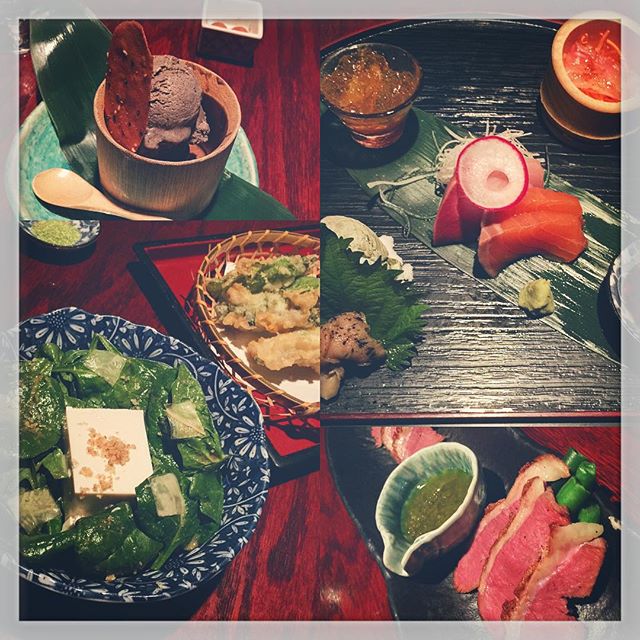
Zenkichi, a Modern Japanese Brasseria, won my heart this summer. A sample of my tasting menu ~ Omakase & Sake flight. I have to say this has been one of the most satisfying coursed meals I have had in a while.

Continue reading Zenkichi Williamsburg Brooklyn Omakase
Exit mobile version