Discovering the Wonders of Alien Planets

the-star-stuff:

A Field Guide to Alien Planets

(January 10, 2011)

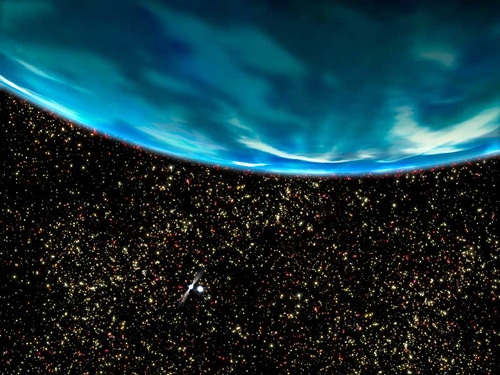
Alien planets come in all shapes and sizes. Generally speaking, these planets — known to astronomers as exoplanets or extrasolar planets — orbit stars outside our solar system, but there are a few surprises out there. Here’s a look at the types of exotic worlds that scientists have discovered so far.

Pulsar planets

The first true discovery of extrasolar planets came in 1994, when radio astronomers discovered worlds around the pulsar PSR B1257+12, about 980 light-years away in the constellation Virgo. A pulsar is not a normal star, but a dense, rapidly spinning remnant of a supernova explosion. The oldest exoplanet known yet, PSR B1620-26 b, nicknamed Methuselah, is also a pulsar planet, located 5,600 light years from Earth in the constellation Scorpius

Hot Jupiters

A “Hot Jupiter” is a gas giant that is as close or closer to its star than Mercury is to our sun. The first discovery of an extrasolar planet around a sun-like star was 51 Pegasi B, an exoplanet roughly 50 light-years away. Of the 429 exoplanets discovered to date, 89 have been hot Jupiters, most likely because their large size and proximity to their stars makes them easier to spot using current techniques.

Exo-Earths

Although the vast majority of the exoplanets found have been gas or ice giants, terrestrial exoplanets most likely outnumber these behemoths, and upcoming missions may soon finally discover rocky worlds the size of Earth with atmospheric conditions that mimic our own. To harbor life, these “Goldilocks planets” would have to orbit their star at just the right distance from  to not roast or freeze — as well as be large enough to retain an atmosphere , but not so large as to become a gas giant.

Super-Earths

A super-Earth is a planet with a mass roughly 10 times greater than Earth’s. The first super-Earths ever found were two of the planets around PSR B1257+12. Super-Earths might be more geologically active than our planet, as astronomers at the Harvard-Smithsonian Center for Astrophysics suggest they experience more vigorous plate tectonics because they possess thinner plates that are under more stress.

Eccentric planets

The planets in our solar system have, for the most part, fairly circular orbits. The exoplanets found so far, however, can have far more eccentric orbits, moving in close and then far from their stars. Where a perfect circle has an eccentricity value of zero, roughly half of exoplanets seen thus far have an eccentricity of 0.25 or greater. These eccentric orbits can cause exoplanets to experience extreme heat waves.

Super Neptunes

Only one “super Neptune” has been discovered so far: In 2009, astronomers discovered a planet somewhat larger and more massive than Neptune orbiting a star 120 light-years from Earth. The solid planet earned the name “super Neptune” because it shares many of the physical characteristics of our Neptune. Neptune has a diameter 3.8 times that of Earth and a mass 17 times Earth’s, the Super Neptune (named HAT-P-11b) is 4.7 times the size of Earth and has 25 Earth masses.

Water worlds

There are two kinds of worlds that might be entirely covered with water . “One is a terrestrial Earth-like planet that’s just covered with a lot more water than our world, like the Kevin Costner movie, but is otherwise still familiar,” said astronomer Charles Beichman, executive director of NASA’s Exoplanet Science Institute. “Or you can imagine a hot Neptune which is almost totally composed of water that is close enough to its star to not be frozen, but instead have an ocean thousands of kilometers deep and perhaps an atmosphere like a gas giant’s, with lots of hydrogen and water vapor.”

Chthonian planets

Sometimes hot Jupiters or hot Neptunes orbit too close to their stars, and the star’s heat and extreme gravity can rip away the planet’s water or atmosphere, leaving behind the rocky core. Scientists have dubbed these evaporated remnant cores “chthonian planets.” Their proximity to their stars could mean they are covered in lava.

Free-floating planets

There are hints that a number of bodies with the mass of gas giants might be free-floating, rather than orbiting a star. These bodies might either have escaped from their suns or never had a star to begin with, born in star-forming regions without the mass needed to ignite.

Rogue planets

A rogue planet is a planet-sized object that has been ejected from its system and is no longer gravitationally bound to any star, so it orbits the galaxy directly. To become a rogue planet, a planetary-mass object would have to be ejected from its solar system, making it starless. This could be achieved by the competing gravitational forces of the sun and larger planets. Also known as interstellar planet, or orphan planet, a rogue planet would require geothermal activity in to sustain life without energy from a star.

KU Designathon 2012

Designathon:
24-hour event where teams of volunteer Communication Design students along with professors and alumni, design and produce pro-bono creative works for non-profits.

I had the chance to work with and direct this talented group of young designers.

  • Emily Snyder
  • Heather Geneva Lewis
  • Peter Hershey

Gift Cards for Charities:
“Currently we are working to establish an orphanage at Lanet-Nakaru to cater for the needs of vulnerable children. The orphanage will be set within a school complex to give the orphaned children a chance to study in our primary school. This orphanage will serve the needs of the people without discrimination regardless their geographical boundaries, religious background, belief, and ethnicity group.”

Detail on Images and link to designers = http://bit.ly/HyELhk | The images above show the development of Navigation layout, wireframes, texture creation, and printed concepts.

Our client requested that we use some traditional african elements, warm colors, images of the children the charity has helped, and easy to understand donation options.

We also discussed future expansion of the site with the client and decided to leave options for a more expansive navigation and additional supporting comment at the bottom of each page.

Urban Outfitters: A Closer Look at Controversies

sleeplessnyc:

defff666:

thedame:

lucymissedtheboat:

onesideofanampersand:

bellepullman:

a-colourfullife:

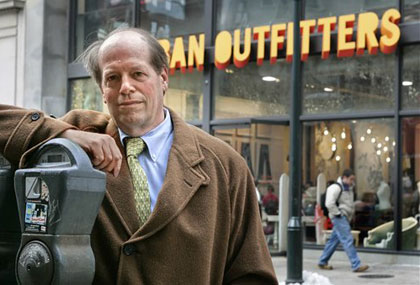
This is Richard Hayne, President and CEO of Urban Outfitters. He’s also a supporter of Rick Santorum and donated over $13,000 to him. He’s against gay marriage and abortion.

His company pulled a pro-gay shirt back in 08, they also blatantly ripped off an Etsy designers work, featured a t-shirt for women that said “eat less” and most recently had a card with a “tranny” slur on in.

Why do you shop at this store? I imagine because you weren’t aware of these facts. Now you are, so stop shopping there.

Well, he’s not a very nice person…

I think everybody should see this…

Glad I’ve seen this, goodbye Urban Outfitters.

Ive always found the store incredibly pretentious! Would rather support Etsy people!

just so you know

Yet another reason to not buy shitty clothes from shitty people.

Not cool

Laser “Unprinter” Saves Paper by Erasing Pages Without Damaging Them

Laser “Unprinter” Saves Paper by Erasing Pages Without Damaging Them

A team at the University of Cambridge has developed a remarkable new technique that uses lasers to erase laser-printed paper, leaving pages clean, clear, undamaged, and ready to be reused. The technology has the potential to be even more eco-friendly than traditional paper recycling – scenarios suggest that it would produce at most “half the carbon emissions of recycling; best-case, unprinting is almost 20 times as efficient,” reports ExtremeTech.

(via READ MORE)

Ernesto Caivano: In the Woods | MoMA-PS1

2004

For MoMA PS1’s stairwell A, Ernesto Caivano created a wall mural based on an ongoing story he developed over three years called After the Woods. While After the Woods consists of drawings and paper sculptures, In the Woods is composed of black latex paint and gouache to create a dense visual web of images composing Caivano’s larger-than-life sized environment. The exaggerated scale of the piece creates a total experience for the viewer, allowing an escape into this imaginary world. Naked and gnarled tree branches wind around the walls and sprout up and out onto the ceiling, entangling the viewer in their dark and magical embrace.

Ernesto Caivano’s In the Woods is located in Stairwell A.

Exit mobile version